


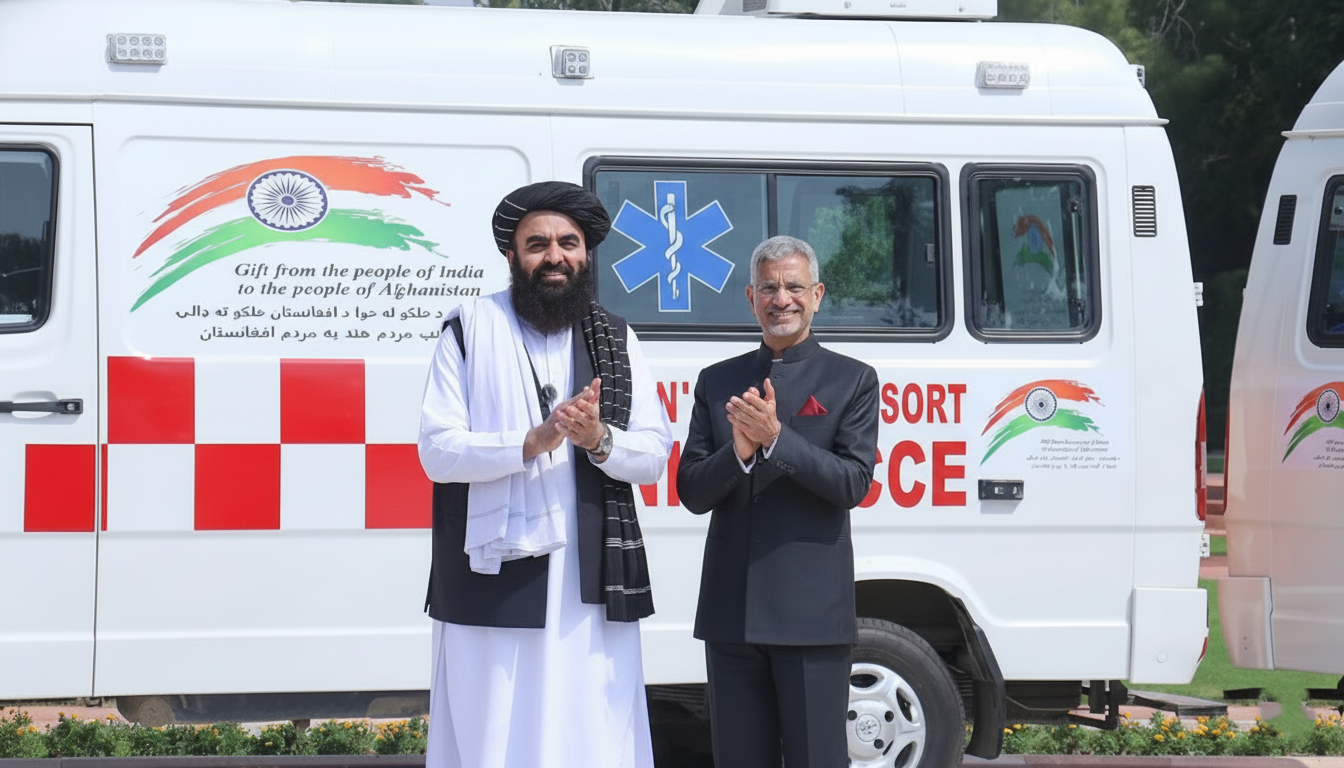
In a significant gesture of goodwill, India has extended vital medical assistance to Afghanistan, reaffirming its long-standing commitment to the welfare of the Afghan people. Recently, the Government of India donated 20 ambulances and essential medical equipment, including MRI and CT scan machines, to strengthen Afghanistan’s healthcare infrastructure. This humanitarian initiative marks another chapter in the enduring India-Afghanistan friendship, built on compassion, cooperation, and regional solidarity.
India’s Medical Aid to Afghanistan: A Lifeline for Healthcare
The Ministry of External Affairs (MEA) of India confirmed that 20 advanced ambulances will be delivered to hospitals across Afghanistan. In a symbolic ceremony held in New Delhi, External Affairs Minister Dr. S. Jaishankar officially handed over five ambulances to Afghan Foreign Minister Amir Khan Muttaqi.
This initiative represents India’s ongoing commitment to support the Afghan people, particularly in the health sector, which continues to face severe challenges due to limited resources and economic constraints.
Medical Equipment and Health Supplies
Apart from ambulances, India has pledged to provide:
MRI and CT scan machines for key hospitals in Kabul and other major cities.
Vaccines for immunisation programs, particularly targeting preventable diseases among children.
Essential cancer medicines and other pharmaceuticals to improve treatment facilities.
These supplies are expected to significantly enhance Afghanistan’s public healthcare capacity, ensuring better access to emergency services and life-saving treatments.


Strengthening India-Afghanistan Diplomatic Relations
This recent medical aid delivery aligns with India’s plan to upgrade its technical mission in Kabul to a full-fledged embassy, signaling an intent to deepen diplomatic and developmental engagement with Afghanistan.
While India has not formally recognized the Taliban-led administration, it has maintained strong people-to-people relations and continues to focus on humanitarian assistance. This balanced approach demonstrates India’s commitment to the Afghan people, irrespective of political changes.
India’s Humanitarian Vision
India’s assistance is not limited to medical supplies. Over the years, it has contributed over $3 billion in infrastructure and development projects, including:
Construction of the Afghan Parliament Building in Kabul.
Development of the Salma Dam (Afghan-India Friendship Dam).
Establishment of schools, hospitals, and community centers across Afghanistan.
This sustained engagement reflects India’s vision of a peaceful, self-reliant, and stable Afghanistan, integrated with the broader South and Central Asian regions.
The Importance of Health Diplomacy
India’s decision to provide ambulances and medical aid comes at a time when Afghanistan’s healthcare system is struggling with shortages of medical equipment, trained personnel, and medicines. The World Health Organization (WHO) has repeatedly highlighted the country’s urgent need for medical support.
By stepping in to address these gaps, India reinforces its image as a responsible regional power dedicated to humanitarian causes. Health diplomacy has become a crucial element of India’s foreign policy, emphasizing soft power and compassion over conflict.
Ambulances: A Symbol of Hope and Relief
The donated ambulances will play a crucial role in emergency medical transport, especially in rural and conflict-affected areas. Each vehicle is equipped to handle critical care patients and ensure faster access to hospitals — a major challenge in Afghanistan’s mountainous terrain.
This move demonstrates India’s practical and people-oriented approach, prioritizing immediate needs such as healthcare access and emergency response.
Humanitarian Assistance Amid Challenges
Despite political and logistical complexities, India has consistently provided aid to Afghanistan since 2021. Over the past few years, India has delivered:
50,000 metric tons of wheat under the World Food Programme (WFP).
Medicines, vaccines, and medical kits through UN humanitarian channels.
Disaster relief assistance during floods and other emergencies.
India’s humanitarian engagement has remained apolitical and people-centric, earning widespread appreciation both regionally and globally.
Global Reactions and Future Outlook

The global community has welcomed India’s humanitarian outreach, recognizing its role in ensuring stability and development in Afghanistan. By providing ambulances, advanced medical equipment, and life-saving medicines, India is bridging critical healthcare gaps that have emerged due to years of conflict and economic hardship.
Moving forward, India is expected to:
Expand its healthcare assistance program in Afghanistan.
Facilitate medical training and capacity-building programs for Afghan health professionals.
Explore regional partnerships with organizations such as the WHO and UNICEF to strengthen Afghanistan’s health infrastructure.
These measures underline India’s consistent vision for a stable, healthy, and prosperous Afghanistan.
Conclusion
India’s recent move to donate ambulances and medical equipment to Afghanistan is more than just an act of aid—it is a reaffirmation of solidarity, friendship, and humanity. By prioritizing healthcare and emergency response, India continues to demonstrate leadership in regional humanitarian efforts, supporting Afghan citizens during one of the most challenging periods in their history.
As India deepens its engagement through healthcare, education, and development, the India-Afghanistan partnership stands as a beacon of cooperation, compassion, and mutual respect in South Asia.


Leave a Reply
Cancel reply